Showing posts with label classical literature. Show all posts

Friday, April 19, 2019

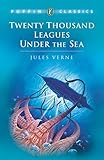
Twenty Thousand Leagues Under the Sea by Jules Verne

Science Fiction

Professor Aronnax is invited on an expedition to find a giant sea creature responsible for eating a hole in a steel ship and almost sinking it. Having a passion for studying the sea, he gratefully accepts and brings his assistant along with him. On the ship, they meet Canadian harpooner Ned Land who will be responsible for taking the beast down. It takes a while, but they eventually find the monster and pursue it. When they get close enough they try a shot at the beast, it looks like it does no damage. The beast takes aim at the ship and Prof. Aronnax and his mate go overboard.

In the water, far away from the ship, they also find Ned Land clinging to what looks like a piece of the beast. But it's made out of steel, surely it's not an animal. Suddenly a door opens and they are brought within this ship and kept captive. The beast they everyone has been trying to pursue is an advanced submarine.

Being kept captive on the ship, the trio is allowed to partake in the adventures they go on. They see things no one but those on the ship have seen and venture to places no one has been. It's obviously Verne had an incredible imagination to pull this book together and, despite it being 100+ years old, still reads like something that could happen today. This is where the book excels, as the characters are a bit weak. There was no purpose to Aronnax's assistant in the book at all. He provided absolutely not value to drive the plot forward. And even the main characters like Aronnax, Land, and Captain Nemo we don't find out too much about.

Even with this, the book's weakest point is the ending. It's like Verne couldn't figure out how to end the book so just gave up and said oh well we're done now. It's unfortunate as otherwise the book was pretty fun.

First Line: "In the year 1866 the whole maritime population of Europe and America was excited by a mysterious and inexplicable phenomenon."

Rating:
(3/5)

Monday, May 02, 2016

Little Women by Louisa May Alcott

Classic Fiction

This classic novel tells the story of the four March sisters in 1860s New England. Their father is off at war so it's just the four of them and their mother, trying to make the best of everything. Christmas is tough and instead of buying things for each other, the girls buy for their mother and give their lunch to a family that has little to eat. Their neighbours hear about their good deeds and send over treats. This sparks up a relationship between the boy Laurie that lives beside them.

I've seen the movie for this book and really enjoyed it. I had started and stopped the book a few times but this time stuck with it. I know this is going to be an unpopular opinion, but wow was this book boring! It's hardly about anything and hardly anything happens. Three of the four sisters have boring personalities. Jo is the only redeeming factor of this book but even she isn't enough to save it.

First Line: "'Christmas won't be Christmas without any presents,' grumbled Jo, lying on the rug."

Rating:
(2.5/5)

Monday, July 13, 2015

Black Beauty by Anna Sewell

Children's

Black Beauty is a beautiful horse with good manners. His mom and first master taught him well so that he doesn't stir at loud noises or abnormal behaviour from other animals or humans. This story tells us the ups and downs of Black Beauty's life as he's passed from owner to owner. The start of his life is great and he is free. Not all of his owners are kind and Black Beauty has to suffer through them. Thankfully, this is a child's story so everything comes full circle and the reader is left with a happy ending.

Once we learn the core beliefs of Black Beauty and his basic personality, the book becomes much more about the situations he's put in. Black Beauty's character doesn't develop much beyond what we learn about him in the first few pages but it doesn't need to because he has such a strong morale base.

This book does a great job of illustrating how abuse feels to animals. Though I'm not sure how a young child would take to either the abuse these animals went through nor the loss that was experienced. It could be rather sad, though the overall message is quite sweet.

First Line: "The first place that I can well remember was a large pleasant meadow with a pond of clear water in it."

Rating:
(4.5/5)

Wednesday, May 27, 2015

Watership Down by Richard Adams

Classic

In a warren of rabbits, Fiver sees that it is no longer safe to stay in their current home. He tells his brother Hazel who knows by now to trust Fiver's instincts. They gather up as many rabbits as they can and wind up with an interesting group because the strongest won't listen to Fiver. The group sets out on their journey, encountering elil (animals that want to hunt them), people, other rabbits, farms, and finally Watership Down. They start to make their home there and then need to start worrying about how to sustain their home without does to mother new bunnies.

When you think of a book about rabbits, you may think children's book. This is definitely not a book for young ones. Though it's an incredibly endearing story of survival, there are some pretty violent and scary parts of the book for young readers.

The characters in this book are what makes it. In the new warren, all the rabbits balance each other out. I really liked seeing some of the less physical rabbits taking charge and other rabbits relying on them for their smarts. The more physical rabbits know how to pull their weight and don't have any problems talking through problems and coming to consensus. Imagine if the business world worked like this book. All businesses would be making billions!

There were times where I thought this book was a bit slow. Rabbits are story-tellers and some of the stories they told, though they parallel what is happening in the book, I felt to slow the pace of the book down a bit too much.

This is a lovely book. Everyone should read it at some point.

First Line: "The primroses were over."

Rating:
(4.5/5)

Thursday, August 15, 2013

Brave New World by Aldous Huxley

Brave New World by Aldous Huxley
Fiction

It's sometime in the future (year 2500 or so) and humans are manufactured in an assembly line, a la Henry Ford. No one has a mother or father, everyone has a specific role in society, and everyone has been conditioned to believe certain things and understand how they should act for the greater good of society. There is no art, everything is about instant gratification, which mostly involves taking a drug soma and having sex. Everyone belongs to each other, which creates a rather different society than what we currently have. Bernard and Lenina are both higher up in society and have, I'd like to say have a relationship with each other but no one really does that in this society. Bernard decides to take Lenina to a compound in the US that has people from the old way of life. He finds a savage, John, and decides to bring him back to the UK for studying. John can't understand how or why people live the way they do. He wants more from life, including relationships, art, and meaning. The struggle between superficial and sincere drives the discovery for John.

I hadn't heard good things about this book but I was surprised that I enjoyed it. You can't really like any of the characters because they are so shallow, with the exception of John, but the way Huxley set up society is intriguing. How would someone from today's time fit with that culture, which is what Huxley explored. The fact that this was written in 1932 and God pretty much equals Henry Ford I found rather interesting. Ford came out with the T model in 1908, which means that less than 15 years after, Huxley had decided that Ford and the assembly line was his inspiration for what the future would look like.

There were a lot of Shakespeare references, which unfortunately I didn't get all of them because I've never read The Tempest. Despite that, I'm not sure it was a good comparison for Huxley. Hamlet was mentioned a couple of times, which was based of pure revenge, and how is that any better than blind following with no relationships?

This book really made me think, though this is partially because at the same time I was trying to figure out how this has become a book that English students read in high school. I don't think I would have appreciated it in high school but I enjoyed it now.

First Line: "A squat grey building of only thirty-four storeys."

Rating:
(4/5)

Tuesday, May 03, 2011

The War of the Worlds - H.G. Wells

The War of the Worlds by H.G. Wells
Science Fiction

A classic science fiction novel written in 1898 (yes, that long ago!) sees martians from Mars lands in Horsell Commons in London. People surround the cylinder, curious to find out what it is and what is inside. The narrator (of whom we never learn his name) is one of the group, witnessing a brown tentacled octopus-like being come out of the cylinder. Then, the martian uses a heat ray to kill the majority of the crowd. The narrator barely escapes.

More cylinders land on Earth and the martians start building 3-pronged machines. This raises the martians high in the air, allowing them to use their heat ray more widely. They also have a black inky-like material that kills all humans on contact. The narrator has some close run ins with these martians, including being stuck in a home for 11 days because another cylinder landed outside the home and trapped him there. At the end, you know what's going to happen, but this books takes you on a journey to get there.

Parts of this book were captivating and parts were fall-asleep boring. I don't think I've ever read a book that fluctuated between the two many times. Whenever the narrator was in trouble, that's when the story got interesting. Was he going to survive? Were the martians going to find and kill him? I also enjoyed reading about how the martians were different from humans. However, there were a few chapters that followed the narrator's brother, which I found rather pointless.

It was interesting to read a science fiction book that was written so long ago. I'm not sure I would recommend it though. It waxed and waned too much for me.

First Line: "No one would have believed in the last years of the nineteenth century that this world was being watched keenly and closely by intelligences greater than man's and yet as mortal as his own; that as men busied themselves about their various concerns they were scrutinized and studied, perhaps almost as narrowly as a man with a microscope might scrutinize the transient creatures that swarm and multiply in a drop of water."

Rating:
(3/5)

Sunday, March 06, 2011

Pride and Prejudice by Jane Austen

Pride and Prejudice by Jane Austen
Classic

It took me a while to get around to reading this one but I'm glad I finally picked it up. This is the story of the Bennet family and the five girls in that family. Mrs. Bennet is trying to find suitors for her girls in early 19th-century England because there are no male heirs to the Bennet estate, if Mr. Bennet dies the girls will be left without a house or income.

During one of the many balls that the girls go to, Elizabeth meets Mr. Darcy and takes an immediate disliking to him. However as the story unfolds she realizes she may have unnecessary prejudice against him.

The name of the book describes the story incredibly well. Each character suffers from either too much pride or too much prejudice. For being written in the early 1800s, the story reads quite well. However it got to a point where I felt like it was too high school "I like him, I don't like him". I just wanted the girls to make up their minds and get on with it. Still, this is a very well written book and understandable why it's a classic.

First Line: "It is a truth universally acknowledged, that a single man in possession of a good fortune must be in want of a wife."

Rating:
(4/5)

Thursday, September 03, 2009

The Scarlet Letter by Nathaniel Hawthorne

The Scarlet Letter by Nathaniel Hawthorne
Fiction/Literature


Whether you've read this book or not, chances are you know what the story is about. Hester Prynne wears a scarlet letter on her chest as punishment for Adultery. She was sent over to New England before her husband, had an affair with an unknown member of society, and ended up with child. She wears the letter on her chest every day and her daughter, Pearl, sees this as normal.

The book is well written and, I'm sure, an English teacher's dream. Never having done that well in English class myself, I can't say I really enjoyed it. I found it incredibly dry in places and sometimes wished Hawthorne would stop babbling and just get to the point already. Point in case, Hawthorne wrote a 46 page introduction to the novel, for a 275 page book!

People say this is a novel of everlasting love but I didn't see it that way. How could two people that love each other so much go seven years without talking to each other, regardless of their circumstances?

Needless to say, this is not my favourite book in the world and I don't think I'll pick up any Hawthorne books in the future.


First Line: "A throng of bearded men, in sad-colored garments, and grey, steepled-crowned hats, intermixed with women, some wearing hoods and others bareheaded, was assembled in front of a wooden edifice, the door of which was heavily timbered with oak, and studded with iron spikes."


Rating:

(2.5/5)

Wednesday, June 20, 2007

Recent Duds

In the past 4 days or so I've had to give up 2 books. I found both of these books way too slow for my liking, so on they go to the next happy reader.

The Secret Supper by Javier Sierra
Historical Fiction


My mom recently read this book and enjoyed it. I started this book with fairly high hopes. It sounded quite interesting, being about Da Vinci's Last Supper. However it was so sluggish that after 40 pages I had to give up. I also found that the author used unnecessarily large words. If you can explain something gracefully and accurately in 2 syllables, why take 10?


Tess of the D'Urbervilles by Thomas Hardy
Classical Literature


This book is actually #26 on the BBC Top 100. I have only heard bad things about it so when I settled down with it, I knew it wasn't going to be an easy read. I found the opening chapter so off the wall that I couldn't quite get over what Hardy was trying to do. If someone were to come up to you and tell you that you look like part of the royal family, would you then assume that you must be part of the royal family and start spending money? This really bothered me.
The book was also quite slow and too wordy. Though I did expect that. I tried to stick it out but I was losing touch with what exactly was going on in the book so I gave up.